Insured person:
Interest on retirement savings
The interest rate in a pension fund is the interest that you, as an actively insured person, receive on your own retirement assets. But who and what decides on the level of interest?
Using the individual coverage model, at TRANSPARENTA, every pension fund - this is what the affiliation of a company is called - finances its own interest rate. This includes the income that it receives as a percentage of TRANSPARENTA's annual result (primarily determined by investment income).
Each pension commission therefore has the option of determining the interest rate for its pension fund itself, taking into account legal and regulatory requirements, and thus deviating from the foundation's applicable default interest rate.
This is how TRANSPARENTA sets interest rates in detail
- To ensure that the process remains as simple as possible for pension funds, the TRANSPARENTA Board of Trustees sets so-called “default interest rates” annually in an interest rate table. This is done in November for the current year (from 2025, earlier in advance for next year). The interest table is based on the investment return achieved up to that point and is pension model and level of coverage is staggered.
- By decision of their pension commission, pension funds may deviate from the recommended value in accordance with the interest rate table — this within the framework of legal restrictions in accordance with Art. 46 BVV2. Such a decision must be notified to the Foundation in writing by 31 December at the latest.
Interest table with default rates for 2025
The interest rate table is staggered according to the level of coverage and differentiates according to the pension model (S for split or U for enveloping). This ensures that the financial position and risk capacity of each pension fund is adequately taken into account when paying interest on retirement assets.
Distinction between interannual and definitive interest rates
To ensure that the withdrawal benefits of departing insured persons can be billed bindingly during the year, a distinction is made between an interest rate during the year and a definitive interest rate:
- The interest rate during the year applies to resignations and the like with the termination of the active pension relationship before December 31 of the current year.
- The final interest rate applies to all insured persons who are actively insured on December 31 of the current year. This also includes insured persons who fully retire as of December 31.
Effective interest rate for the last 5 years (Ø of all pension funds)
The list shows the effective interest rate on retirement assets, including the distribution of free funds, over the last 5 years. The figures are to be understood as a capital-weighted average of all pension funds. For the individual insured person, the interest rates of their employer's pension fund were decisive.
- 2025: 2.5% (highest interest rate: 6.0%)
- 2024: 2.2% (highest interest rate: 9.0%)
- 2023: 1.3% (highest interest rate: 4.0%)
- 2022: 2.3% (highest interest rate: 10.0%)
- 2021: 1.9% (highest interest rate: 10.0%)
Compared to the interest rate on bank savings accounts or pillar 3a products, insured persons benefited from an attractive interest rate from their pension fund while maintaining a high level of security.
Distribution of free funds
In Order to Improve Performance, the Pension Commission of Your Pension Fund can also decide to distribute free funds via a distribution plan instead of raising the interest rate.
In addition to retirement savings, the distribution plan can take into account other criteria, such as insurance years. Compared to the additional interest rate, we recommend this only when the free funds to be distributed amount to at least 3% of the retirement assets (i.e. from a coverage ratio of 118%). Before that, raising the interest rate is the most efficient way.
Purpose of Interest: Maintain the Purchasing Power of Money — for Decades
The interest rate on retirement assets is primarily used to maintain and ideally expand the purchasing power of savings contributions paid over 40 years over an entire working life. One speaks of expansion when a positive real interest rate is achieved. Depending on the definition, this is the case when the effective interest rate on retirement assets is higher than the inflation of money (inflation rate) or individual wage increases (wage growth rate) of the insured person.
Why interest is not equal to investment return
With TRANSPARENTA, you always benefit from 100% profit-sharing. This is because what is not directly credited to insured persons as interest on retirement assets flows into the collective reserves of their own pension fund.
- Example: If the investment yield is 10% and the interest rate is 2%, the surplus of 8% flows into the reserve and improves the coverage ratio.
The Reserve Cushion built up in good times helps to cushion bad times as a result of stock market crashes (such as in 2008, 2018 or 2022).
The reserve level is measured by the coverage ratio. A coverage ratio of 110% means that pension fund obligations (i.e. the retirement assets and pension capital of insured persons) are covered by a buffer of 10%.
- Example: If the obligations amount to CHF 1,000,000, there are CHF 100,000 reserves available.
This clever reserve system enables insured persons to earn positive interest even in the occasional years of loss. This is because existing reserves can cover investment losses or pay the interest to be credited.
The interest rate applicable to you is based on your personal Pension statement specified. It can be found under the “Personal Data” section with reference number 1. The interest actually credited in Swiss Francs for the previous year can be found on the pension statement as of January 1 in the “Account Statement” section.
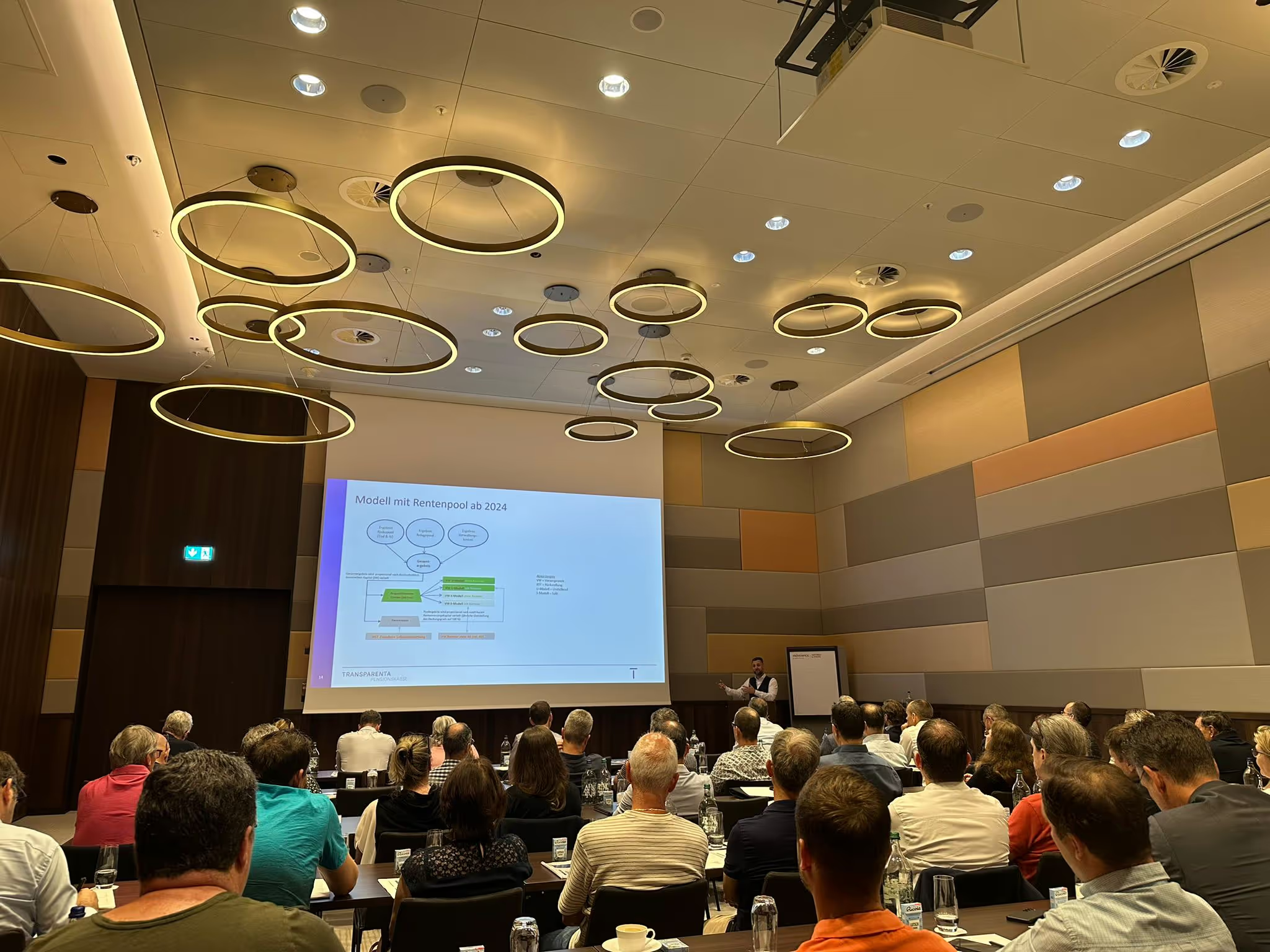

Anlass für Vorsorgekommissionen - 12. Juni 2025
Das TRANSPARENTA-Team durfte am 12. Juni 2025 gegen 60 VK-Mitglieder der angeschlossenen Vorsorgewerke im Hotel Mövenpick in Basel begrüssen. Kurzweilig, lernreich und inspirierend sei der Nachmittag gewesen, so das erfreuliche Urteil aus dem Kreis der Gäste. Einen besonderen Höhepunkt bot das fesselnde Gastreferat von FCB-Ehrenpräsident Bernhard Heusler.